Was Anubis Evil? The Truth Behind Egypt’s Most Misunderstood God
If you picture Anubis, you probably picture a threat: a black jackal head on a man’s body, standing guard somewhere between the living and the dead. Pop culture has cast him as a villain so many times — video game bosses, horror movie monsters, the brooding antagonist in a dozen Egyptian-themed stories — that it’s easy to assume the ancient Egyptians felt the same way about him.
They didn’t. Dig into actual **Anubis mythology** and a very different god shows up: not a monster, but one of the most trusted figures in the entire Egyptian pantheon.
To the people who actually worshipped Anubis for over 3,000 years, he wasn’t the thing to fear in the dark. He was the one who kept the dark from winning.
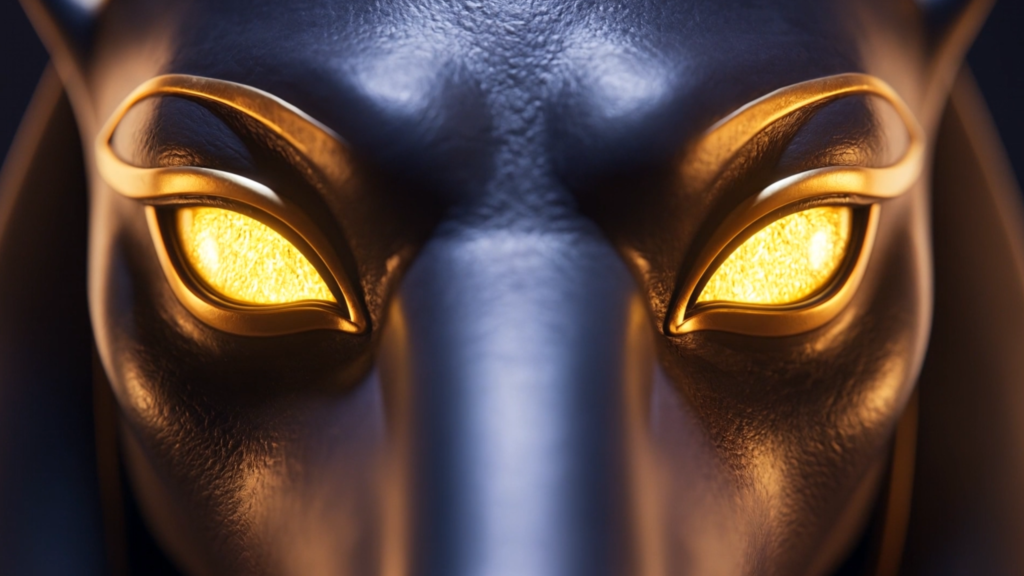
“They called the jackal god a thing to fear… but Anubis was never death’s villain — he was its guardian.”
Who Is Anubis, Really?
Anubis (originally called *Inpu* or *Anpu* in ancient Egyptian) was the god of mummification, funerary rites, and the protection of graves. He’s almost always shown as a black jackal, or as a man with a jackal’s head — an image the Egyptians chose deliberately, because jackals were commonly seen scavenging near burial grounds. Rather than treat that as a threat, Egyptian religion did something clever: they made the jackal a guardian instead of a grave-robber.
Anubis was one of the very oldest gods in the Egyptian pantheon, worshipped as early as the First Dynasty, long before more famous names like Osiris or Isis rose to prominence. For centuries, he *was* the primary god associated with death — not a secondary or sinister figure, but the central authority over what happened to a person after they died.
Why Does Anubis Look Like a Jackal God?
The “Anubis is scary” instinct comes from a modern lens, not an ancient one. Western storytelling — heavily shaped by Christian ideas of Hell, the Devil, and eternal punishment — tends to assume that anything associated with death must be evil by default. Ancient Egyptians didn’t think that way.
In Egyptian belief, the real enemy wasn’t death. It was **chaos** — the collapse of order, the loss of identity, a soul left unprotected and unable to reach the afterlife. Anubis existed specifically to prevent that outcome. Every duty associated with him — embalming the body, guarding the tomb, escorting the soul — was an act of protection, not punishment.
Black, the color most associated with Anubis, reinforces this. To modern eyes black reads as ominous. To the Egyptians, black symbolized the rich, fertile soil of the Nile floodplain — and by extension, regeneration, fertility, and rebirth. Anubis’s black coat wasn’t a warning sign. It was a promise of renewal.
The Book of the Dead and the Weighing of the Heart
Anubis’s most famous role appears in the *Book of the Dead*, in a ritual called the **Weighing of the Heart**. Here, Anubis personally leads the deceased into the Hall of Truth and places their heart on one side of a great scale. On the other side sits a single feather — the symbol of Ma’at, the goddess of truth, balance, and cosmic order.
If the heart is lighter than the feather, the soul passes into the afterlife. If it’s heavier, weighed down by wrongdoing, it’s devoured by Ammit, the crocodile-lion-hippo demon waiting beside the scale.
It’s a dramatic scene, and it’s easy to read Anubis as the executioner in this story. But look closer at what he’s actually doing: he’s not the one judging guilt, and he’s not the one administering the punishment. Anubis operates the scale with scrupulous fairness — he’s the impartial official making sure the process is honest, for *everyone*, regardless of who they were in life. That’s not the role of a villain. That’s the role of a guardian making sure the system can be trusted.

Anubis vs. Osiris: Who’s Really the God of the Dead?
One of the most common points of confusion is the overlap between Anubis and Osiris. Here’s the short version: Anubis held the role of supreme god of the dead first, during Egypt’s Old Kingdom. As the cult of Osiris grew during the Middle Kingdom, Osiris took over as ruler of the underworld — and Anubis was folded into the mythology as his loyal assistant, embalmer, and enforcer of the judgment process.
Rather than losing relevance, Anubis became even more essential to the *mechanics* of death and the afterlife. Osiris ruled the underworld from his throne. Anubis was the one who actually got you there safely.
What Anubis Actually Stood For
– **Protector of the dead** — guarding tombs against robbers and desecration
– **Inventor of mummification** — the god credited with first embalming a body (Osiris’s), preserving it for the afterlife
– **Guide of souls** — leading the dead safely through the Duat, the Egyptian underworld
– **Guarantor of fairness** — operating the Weighing of the Heart with impartiality, not cruelty
For ordinary Egyptians, this made Anubis a source of comfort, not dread. Death was inevitable. Having a powerful, meticulous, incorruptible god standing between you and oblivion was reassuring.
See Anubis’s Story Brought to Life
Want to see this myth told the way it deserves — full cinematic scope, the Weighing of the Heart rendered in stunning detail, and the truth behind Egypt’s most misunderstood god? Watch our full animated retelling of Anubis on the MythWorks Studios YouTube channel.
👉 *[Watch “Anubis: God of Judgment” on YouTube]*
Learn more about the Anubis myth from trusted sources like Encyclopedia Britannica.
Watch our full cinematic retelling of the Anubis myth here.